פָּרָשַׁת עֵקֶב
Parshas Eikev: The Wooden Box
Rabbi Adi's weekly Dvar Torah • 16 Av 5786
When I was a kid, around 12 to 14 years old, I was part of a small group in our community with a special job. Every Friday night at the Tish, the Shabbat gathering around the Rebbe's table filled with singing and Torah, the Rebbe would give the weekly Dvar Torah. We could not write anything down. So we listened. We held every word in our heads. And on Motzei Shabbat, as soon as Shabbat ended, we would sit down together and write it all out from memory.
It was the best possible training for my memory, and it is a memory I treasure.
I love Rabbi Adi's weekly Dvar Torah on our call, and I wanted to go back to that old practice: capture it, write it down, and put it together with some explanations so that my kids can understand and enjoy it too. The explanations are my additions. The Torah is Rabbi Adi's.
This week's parsha is Eikev, in Sefer Devarim, the fifth and final book of the Torah. Devarim is largely Moshe speaking to Bnei Yisrael at the end of his life, retelling things that already happened.
But here is the key: whenever Moshe retells something, he adds a small detail that was not there the first time, and that detail carries a lesson. For example, last week's parsha repeated the Aseres HaDibros (the Ten Commandments). The first time the Torah gave the commandment of Shabbat, it said Shabbat is a remembrance of the creation of the world. In Moshe's retelling, he adds that Shabbat is also a remembrance of leaving Egypt. That is why the Friday night Kiddush mentions both. The additions matter.
This week, Rabbi Adi taught, there is another one of these additions, and it holds a very big lesson.
To understand it, you need the timeline of what happened after leaving Egypt:
Bnei Yisrael leave Egypt on Pesach. They count 49 days and reach Shavuos, when the Torah is given at Har Sinai. Moshe goes up the mountain for 40 days and 40 nights to learn the entire Torah with Hashem and receive the Luchos, the two stone tablets on which the Ten Commandments were carved.
He comes down on the 17th of Tammuz, and it is one of the saddest days in our history: Bnei Yisrael have sinned with the Golden Calf. Moshe smashes the Luchos on the ground.
Then Moshe spends 40 days and 40 nights begging Hashem to give the people a second chance. At Rosh Chodesh Elul, the first day of the month of Elul, about 40 days before Yom Kippur, he goes up a second time for another 40 days and 40 nights. He comes down on Yom Kippur, carrying a second set of Luchos, and Hashem says “Salachti kidvarecha,” I have forgiven, as you asked. That is why Yom Kippur is, at its core, the happiest day of the year: the day we were forgiven.
Before Moshe goes up the second time, which is described in this week's parsha, Hashem gives him a strange instruction: make a wooden box. Carve a second set of Luchos, and when you come down, put them in this plain wooden box.
Here is the problem. We already know from Parshas Terumah where the Luchos are supposed to live: in the Aron HaBris, the Ark of the Covenant, the holy chest built to hold the Luchos, which stood inside the Mishkan, the Tabernacle, the portable sanctuary Bnei Yisrael carried through the desert. And the Aron was not a plain wooden box. It was built as three boxes nested inside each other: a gold box on the outside, a wooden box in the middle, a gold box on the inside, with the Keruvim, the two golden angel figures, spreading their wings on top.
So why does Hashem tell Moshe to make a simple wooden box? And why does the parsha emphasize it about four times: Hashem said make a wooden box, Moshe made the wooden box, he put the Luchos in the wooden box, exactly as Hashem said? Once would have been enough.
Rashi, the Ramban, Rabbeinu Bachya, and others explain the practical piece. When Moshe came down on Yom Kippur, there was nowhere to put the Luchos. The Mishkan had not been built yet; it was only completed later. And even once construction began, Betzalel, the master craftsman chosen by Hashem to build the Mishkan and everything in it, had to build the structure first and only then the vessels, “because you can't buy a couch before you have a house,” as Rabbi Adi put it. First the house, then what goes in it.
So the wooden box was the temporary home for the Luchos, kept in Moshe's tent until the Aron was ready.
And what happened to the box afterward? The Gemara in Megillah teaches that anything that held something holy cannot simply be thrown away; it must be treated with respect, the way a bag that held tefillin keeps its dignity even after you stop using it. One of the commentators explains that this wooden box was not discarded at all: it became the middle wooden layer of the Aron itself, sandwiched between the two gold boxes.
Beautiful. But this makes the question stronger, not weaker. If Hashem knew the box would end up inside the Aron, why not just tell Moshe to build the small inner gold box and be done with it? Why insist, four times, on wood?
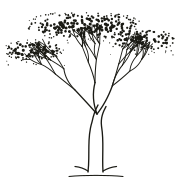
The Torah compares a person to a tree: “ki ha'adam eitz hasadeh,” for man is a tree of the field. Why a tree? Because a tree is cyclical. It blossoms, it bears fruit, and then winter comes and the leaves fall off and everything looks dead. But we know that after winter comes spring, and the tree blossoms again.
That is the message of the wooden box. A person can always fix himself. No matter what happens, there is always a step forward. Even after we mess up badly, we are like the tree: a rough season, and then, if we take it upon ourselves, we blossom again.
That is why the Aron needed a layer of wood. The Menorah was pure gold. The Shulchan was gold-plated. But the Aron, the home of the Torah itself, had to have wood hidden at its heart. And even though inside and out it was gold, the Torah often calls it the Aron atzei shittim, an ark of acacia wood. Remember those two words, atzei shittim. They will come back at the end.
This is also what Hashem said to Adam HaRishon after the very first sin. Hashem called out “Ayeka?” Where are you? Meaning: why are you hiding? Yes, you made a mistake. Get up. Continue. Keep growing.
Now the name of the parsha itself. It opens “V'haya eikev tishme'un,” and everyone asks about the unusual word eikev, which literally means “heel.” Why that word?
The Vilna Gaon teaches that the first time a word appears in the Torah tells you its deepest meaning. The first time “eikev” appears as a lesson is with Avraham, right after the Akeidah. The Akeidah, the binding of Yitzchak, was Avraham's greatest test, the last and hardest of the ten tests Hashem gave him. After waiting a hundred years for a son, Hashem asked Avraham to bring that very son, Yitzchak, up Har HaMoriah as an offering. Avraham got up early in the morning and went, without argument and without delay, and only at the very last moment did an angel call out and stop him, because Hashem never intended for Yitzchak to be harmed; He wanted to see how far Avraham's trust would go. Right then Hashem says “eikev asher shamata b'koli,” because you listened to My voice, blessing will follow you.
Avraham's whole life was the heel: one step, then another. He was promised a child and a future, and he waited decade after decade, through test after test, well past what any person could bear. But he kept walking, one foot in front of the other, because he knew the ultimate goal.
The takeaway
Why did Hashem insist on a wooden box, and not gold? Because before the Torah could have its permanent golden home, Hashem wanted its first home, and its hidden heart forever after, to be wood.
This is why we sing “Eitz chaim hi lamachazikim bah,” it is a tree of life to those who hold onto it, every time the Torah is returned to the ark in shul. The Torah lives in wood, because wood is the thing that looks dead in winter and blossoms anyway.
The Bar Yochai song
Up to here, the Torah is Rabbi Adi's. I am not one to add to it. But his words about Atzei shittim reminded me somthing, and with his forgiveness I write them down here. A song we sing on Lag BaOmer, Bar Yochai, in honor of Rabbi Shimon bar Yochai. One of the stanzas goes:
בַּר יוֹחַאי עֲצֵי שִׁטִּים עוֹמְדִים, לִמּוּדֵי יְיָ הֵם לוֹמְדִים
אוֹר מֻפְלֶא אוֹר הַיְקוֹד הֵם יוֹקְדִים, הֲלֹא הֵמָּה יוֹרוּךָ מוֹרֶיךָ
Bar Yochai, standing acacia trees, disciples of Hashem, they learn; a wondrous light, a blazing fire, they burn; surely they, your teachers, will teach you.
“Atzei shittim omdim,” the standing acacia trees. These are the very words Rabbi Adi used for the Aron, and they are taken straight from the Torah's instructions for building the Mishkan: “And you shall make the beams for the Mishkan of standing acacia wood” (Shemos 26:15). The song is comparing great Torah scholars to those very beams. The deeper teachings connect these standing trees to the two great pillars that stood at the entrance of the Beis HaMikdash, called Yachin and Boaz, which in turn correspond to the sefiros of Netzach and Hod, endurance and splendor, the qualities of standing firm and standing humbly.
Think about what that means. The walls that held up the Mishkan, the house of the Luchos, were living trees that were cut down, and yet the Torah insists on calling them omdim, standing. Still standing. The scholars in the song are the same: trees that stand, that learn, and that burn with light. It is the whole lesson of the wooden box, sung around a bonfire.
The last word
When you hit a rough patch, and everyone does, remember the tree. The leaves fall off. And then it blossoms and bears fruit. Just keep moving forward, one foot in front of the other.